Josh Gaylor’s journey into the world of footwear began with a postcard of an illustration. Picked up at an exhibition in Manchester during his student days, that small piece of paper representing an adidas Y-3 collaboration changed everything. It transformed shoes from simple consumer products into a canvas for storytelling. Today, as a Lead Designer at Jordan and a juror for the Global Footwear Design Awards, Gaylor uses that same sense of wonder to navigate the complexities of high-performance design and streetwear culture.
What makes Gaylor’s perspective stand out is his roots in skateboarding and engineering. He understands that a shoe is only as good as its weakest point, having spent years identifying exactly where materials fail under the pressure of the street. He advocates for a return to the workshop, urging designers to step away from their screens and get hands-on with manual knitting machines and pattern cutting. For Gaylor, the future of the industry is about “passionate curiosity” and creating products that last and not about chasing the latest fleeting trend. In this conversation, he shares his thoughts on the power of authenticity and why the best designs always start with a clear answer to the word “why.”
You’ve worked across a wide spectrum of the industry, from innovation labs to high-performance running. As a juror for this year’s Global Footwear Design Awards, what is the single most important quality you are looking for in a winning submission?
I think for me the biggest thing is to have a clear insight as to why you’re pitching the project. All decisions revolve around the why? Provide context. Whether it’s a design tweak to improve an issue or a consumer insight to ground the development of a project. Even better if you can draw from either your own or another person or user group’s insights to inform the decision-making process. For a winner, I think if you’re able to problem solve efficiently and evoke the emotions you are trying to portray, you’ve put yourself in a great position to be selected.
With the footwear industry becoming increasingly crowded, how do you distinguish between a trend-chaser and a designer who is actually pushing the industry forward? What acts as that “tie-breaker” for you when judging?
Typically, authenticity shines through, and I think that’s felt even at the brand level that stories that are told by the people who were there at the grassroots and built the scenes carry far more weight than designers and brands following trends. People who have a knock-on effect on the wider industry usually are carving their own niche through exploration, continual refinement and exploring new spaces. In a tie-break situation, self-reflection about improvements and what worked and what didn’t would show me that you’re likely to take on board the learnings into a future project.
You’ve shared a story about keeping a Y-3 postcard above your desk that sparked your career. Looking back, what was it about that specific visual that convinced you that footwear was a medium for storytelling?
For context, I was looking to apply to university degree courses, and I was at an exhibition for Hacienda nightclub showcasing Peter Saville and his work for Factory Records in Manchester. They had an adidas Y-3 x Fac23 collaboration, and as a small takeaway from the exhibition was an illustration of the shoe. Holding the postcard with the shoe illustration on, it felt like it was tangible for me to have been the one who made it—to say I could see myself. The lore around coveted footwear, specifically the early Nike SB years, really opened my eyes to the potential to work with communities and tell their stories. It’s a way to give back in that sense, meet people, listen and tell their stories to people outside their sphere.
You have a background in engineering and a deep history in skate culture. How does the “skater’s mindset”—the experience of destroying shoes—inform the way you build products today?
From a practical standpoint, in skateboarding you’re subjecting your shoes to a constant abrasion test; the repetitive nature of the movements creates hot spots and weaknesses which you’d never experience with normal wear. Over the years, you develop a feel for the different types of materials and how they interact with different surfaces. These pairings of materials create an experience and value to the touch points. From an aesthetic standpoint, there is a style element to pair shoes with an outfit and your skating style. Creating a product which speaks to both is an art in and of itself. I take this specifically into the streetwear spaces, as street skateboarding and streetwear go hand in hand in my opinion.
You’ve moved from graphic design into specialised material design, even working on manual flat knitting machines. Why is it important for a modern designer to get their hands dirty with manufacturing equipment?
I feel that getting hands-on is very important to learn through failures. Building patterns, cutting, assembly and wear testing are all crucial aspects to developing as a footwear designer. Through the problem-solving aspect of figuring out a design physically, you’ll often be faced with decisions that’ll change the look of the design. There are digital tools which have further disconnected designers from physical making, and whilst they’re a great tool for exploration, getting hands-on enables you to gain a feel that’s not possible otherwise. Specifically to the textile space, building textiles from scratch provides insights as to why certain techniques get the looks they do and can inform a design expression entirely.
How do you translate a narrative like a brand’s history into physical materials on a shoe without the design feeling like a costume?
This is a bit of a paradox as the community aspect of both style and design speaks to both ends of the spectrum of commerciality, and both ends can’t live without one another. There are levels to the commerce spaces to which we speak. On the upper end of taste levels, it is about finding a balance of referencing and remixing elements and offering a “if you know you know” aspect, where details can often be overlooked. The more literal “costume” is as much about being a part of something bigger than ourselves and the shared identities. These cultural moments are expressed along a variety of different taste levels to speak to the same topic through multiple expressions.
Where do you see the biggest opportunity for meaningful, sustainable change in the way we manufacture footwear?
There are multiple ways to look at utilising the supply chain to build products, either for disassembly or mono material approaches built for recycling. When comparing costing from these programs to locally sourced material nearer the factories, the sustainability initiatives for oil-based materials can’t compete and never scale to make a measurable impact on the wider industry. I feel there’s a lot to be said for simply being able to service footwear and build for longer product lifespans through quality. The craft aspect and the skilled labour are worth the premium when looking at sustainability.
In a high-pressure industry, how do you cultivate an environment where mentorship and shared growth can actually thrive?
In design, we have a duty to do what is best for the consumer, led by the brief. Tensions can be high, but by fostering an environment of emotional safety and being able to speak freely whilst being open to others’ perspectives can create an environment where people feel heard and have a sense of shared ownership. In these conditions, we can grow. I’ve had help and guidance along the way from people I didn’t expect to take time to help me and I feel you have to pay it forward and take time for people to help them grow, too.
As you step into your new role as Lead Designer at Jordan, what is the biggest lesson from your past roles at Puma and adidas that you are excited to apply?
Simply—don’t go in with any pre-conceived notions of what something is going to be, so always be open to change.
If you were to give advice to a young student starting out today, what is one skill that isn’t taught in design school that they absolutely need?
An ex-manager of mine would always say, “Remain passionately curious.” Those words, as simple as they are, have stuck with me.
Thank you for inviting me to be a part of the Global Footwear Design Awards jury.
Header: Dominik Scherrer
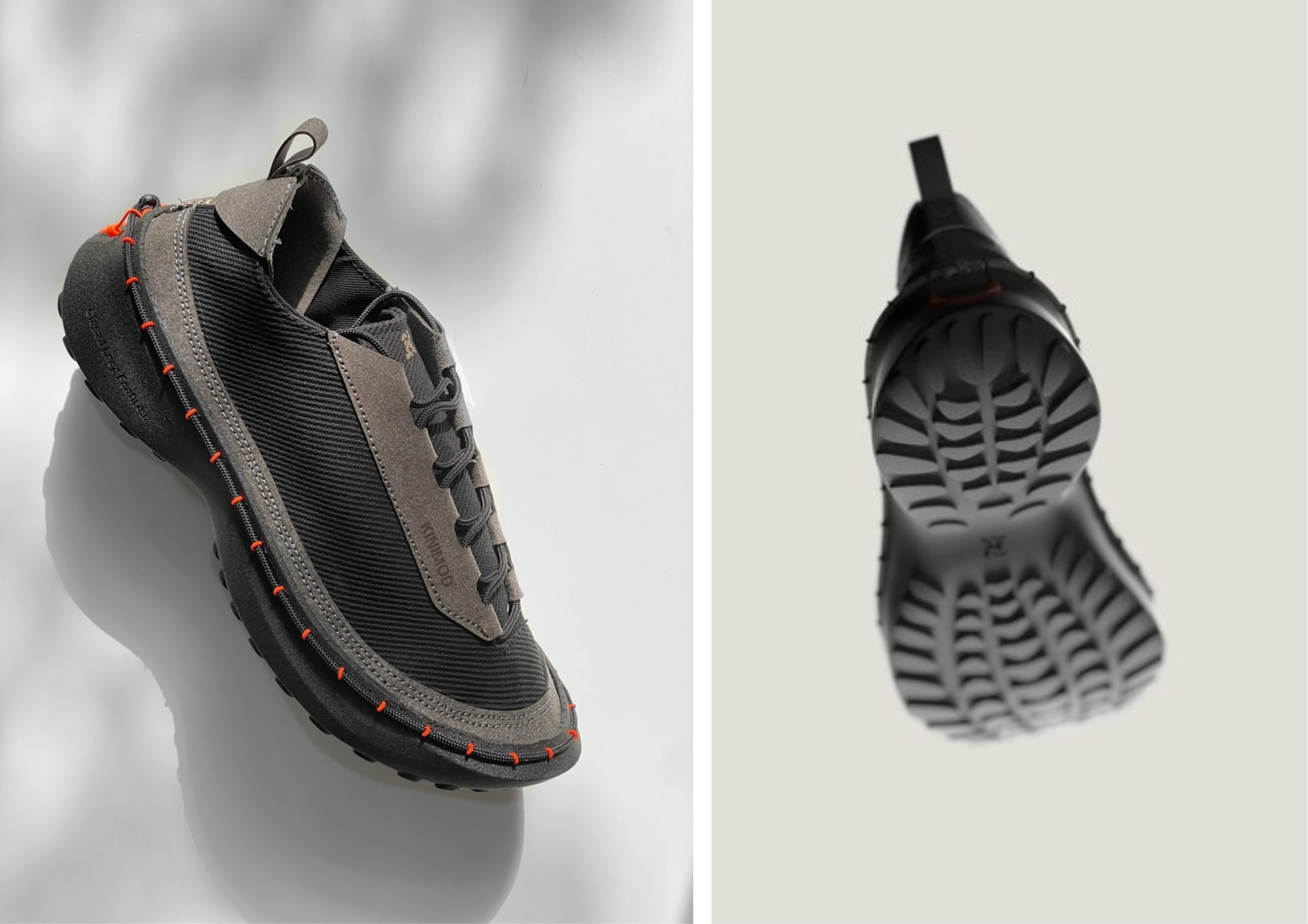
Dominik Scherrer belongs to a fresh group of designers who are changing how we think about making and wearing shoes. After winning the Emerging Footwear Designer of the Year 2025 at the Global Footwear Awards, he has gained a lot of attention for his project, Closed Loop Footwear. Instead of following the usual way of making shoes, Dominik looks at them as technical systems. He focuses on modular parts that users can put together themselves, making it easier to fix or recycle them later on.
With a background in mechanical engineering and a deep interest in eco-friendly design, Dominik treats shoemaking as a puzzle to be solved. He digs into the messy problem of how to take shoes apart and reuse the materials, which is one of the toughest challenges in fashion today. In this talk, he explains the moment in his studies when he started to doubt traditional factory models and how using bits of banana fibre and hemp leather helped shape his award-winning trainers. He also talks about how his win at the Global Footwear Awards has given him the push to keep questioning the status quo.
Closed Loop Footwear approaches sustainability through modularity, self-assembly, and decentralised production. What moment during your studies made you question the traditional footwear manufacturing model?
During my Master’s, I focused on Eco-Innovative Design and became more and more aware of the positive and negative influence design has on product development. Throughout the program, it became clear to me that some product categories are easier to approach sustainably than others. Footwear is definitely one of the more difficult ones. Shoes combine many different materials, are often glued together, and are produced in highly globalised systems. Achieving real sustainability under those conditions is challenging. That realisation made me want to focus my thesis on footwear – because it’s complex and difficult.
Your background in mechanical engineering clearly influenced the project. How did technical thinking influence your design decisions differently than a purely aesthetic approach might have?
My technical background brings an analytical and strategic counterpart to the sometimes chaotic and emotional design process. I think both sides are important – they just play different roles depending on the phase of the project. Functionality and real-life feasibility were always important to me. That partly comes from my engineering background, but also from what I learned at university and through my previous jobs. I tend to think about how something can actually be built and used from the very beginning, not only about how it looks.
Designing for disassembly and repair requires users to engage with the product. Was the idea of user participation always part of your vision of a circular sneaker?
Not from the start. I had earlier concepts that didn’t include self-assembly or self-repair. In the end, I decided to include self-assembly because I believe it can create a closer relationship between the user and the product. When people are involved in assembling something themselves, they might value it more – and that can support longevity. So user participation became part of the concept during the development process.
The project uses materials like banana fibre textile, hemp leather, and recyclable TPU. How did material experimentation shape the final form of the shoe?
Material research played a big role in the project. Bananatex (banana fibre textile) and Revoltech LOVR (hemp-based material) showed strong potential from a circular perspective, but I needed to understand how they actually behave. Through testing – cutting, sewing, forming – I learned what the materials can and cannot do. The current form of the shoe is very much a result of those findings. The construction adapts to the materials rather than forcing them into a conventional shoe design. At the same time, only wear testing will show whether the materials are used in the right way or if certain details still need improvement.
Being named Emerging Footwear Designer of the Year at the Global Footwear Awards 2025 while still at an early stage of your career is significant. How does this recognition influence your confidence and direction as a designer?
Awards like the GFA are definitely a confidence boost, especially at an early stage in my career. They show me that the topics I’m working on are relevant beyond the academic context. Since it’s the first award I’ve won as a designer, it has a special meaning for me. It also helps to give visibility to my work as an independent industrial designer, which I really appreciate.
Academic concepts can struggle to translate into reality. What aspects of Closed Loop Footwear do you believe are immediately applicable beyond the classroom?
The exact construction still needs further development before it can be applied in a real production environment. However, the loop-based construction principle itself could be implemented relatively soon for certain types of footwear. For example, injection-moulded soles combined with 3D-knitted uppers could be a realistic first step. While 3D printing is not yet widely used in footwear production, I’m confident that digital and additive manufacturing will continue to grow and become more relevant in the future.
Looking forward, do you see yourself pushing circular systems within industry, or building alternative production models outside of it?
I think it should be a mix of both. Supporting the development of circular systems within the established industry is important because of its scale and impact. At the same time, alternative models can explore new ideas more freely and show what a circular future could look like. Ideally, I’d like to work somewhere between those two worlds – contributing to change within industry while also developing independent concepts that challenge existing systems.
Header: Courtesy of David Solk
When most people think about shoes, they think about how they look on the shelf or feel on a run. David Solk, however, is more interested in what happens when you’re finished with them. As the co-founder of the footwear brand SOLK, David has moved away from the standard way of making sneakers. Instead of trying to fix a messy global system, he decided to start from scratch. His goal was simple but difficult: create a high-quality sneaker that can eventually return to the soil without leaving a trace of plastic or chemicals behind.
This ground-up approach has already caught the industry’s eye. SOLK recently took home the Footwear Brand of the Year 2025 at the Global Footwear Awards, a massive nod to their “biocircular” method. In our conversation, David explains that this isn’t just about using a few green materials; it’s about owning the whole process, from the first stitch to the moment the shoe is sent back to be composted. He talks us through the reality of building a brand that puts the earth first, the technical headaches of making plants feel like leather, and why he believes the best design is often about taking things away.
SOLK is built entirely around biocircularity, not as a feature but as a foundation. What personal or professional frustration pushed you to rebuild the sneaker from zero instead of improving an existing system?
For Irmi and me, it wasn’t a dramatic moment — it was more gradual than that. We’d spent years trying to make footwear better from within. Inspired by brands like Patagonia in the mid-2000s, we worked with clients to introduce more responsible materials and processes into conventional manufacturing. We genuinely believed steady progress would add up. Then the financial crisis hit, and sustainability quickly became secondary.
Budgets tightened, priorities shifted, and the momentum we’d worked so hard to build slowed right down. That period gave us space to reflect. We realised that while incremental improvements matter, the overall system itself hadn’t really changed. Shoes were still being made in ways that didn’t consider what happens at the end of their life. It wasn’t about thinking the industry was “broken.” It was more of a feeling that we hadn’t quite addressed the full picture. If a product can’t safely return to the earth, then something is still unresolved.
At that point, the idea of starting from scratch began to feel less radical and more logical. We wanted to see what would happen if responsibility wasn’t an add-on or a percentage improvement, but the starting point. So, we decided to build it ourselves — carefully, independently, and without outside pressure. The ambition wasn’t just to make a more sustainable shoe, but to rethink its entire lifecycle. That thinking eventually became biocircularity — not as a feature, but as the framework guiding every decision.
Fade 101 is designed to return safely to the earth, yet it still needs to perform as an everyday sneaker. What was the hardest material or production challenge in making compostability compatible with comfort and durability?
The hardest part was unlearning what we thought we knew. Footwear today is built around materials designed to last indefinitely. We were trying to engineer materials that perform in everyday life but can return to earth at the end of it. That’s a very different brief. We had to rethink everything — how the upper is built, how components bond, how materials behave over time. Compost-capable materials don’t always act like conventional ones, and you can’t simply swap them in. We also had to redefine performance. It wasn’t about extreme lab metrics. It was about real comfort, durability, and how the shoe feels months down the line.
Controlling the full lifecycle, from manufacturing to take-back, is rare in footwear. Why was owning the end-of-life process just as important as designing the product itself?
For us, producing shoes ourselves was almost a necessity. The way we build SOLK is very specific. Every component matters — down to the backing materials and the threads. If someone accidentally swaps in a conventional nylon thread or the wrong reinforcement, the whole concept starts to unravel.
It’s not about mistrust — it’s just the reality that most factories are set up for conventional production. The only way for us was to be directly involved in how it’s made. Once we took that step, owning the take-back felt like a natural extension. It’s about making the whole thing tangible — not just an idea, but something customers can actively participate in.
Aesthetically, Fade 101 is intentionally timeless. How did you approach design decisions knowing the sneaker’s eventual disappearance is part of its story?
From the beginning, we wanted SOLKs to be someone’s go-to sneakers — the pair by the door that you reach for without thinking. That meant being quite disciplined with the design. We focused on proportion, simplicity and engineering the product so that every detail is there for a reason, for function and comfort.
Winning the Footwear Brand of the Year at the Global Footwear Awards 2025 places SOLK on a global stage. How does this recognition validate your model, and does it change the way you see the brand’s responsibility moving forward?
We’re really honoured to receive Footwear Brand of the Year. For us, it feels like recognition of the whole idea — not just the design of the shoe, but the thinking behind it. Awards like this are encouraging, but they also come with responsibility. If we’re questioning how footwear is normally made, we have to keep showing that our approach works — in real life, at scale, over time. At the end of the day, the goal is still simple: make sneakers people want to wear, and make sure they’re harmless at the end of life.
Sustainability often comes with trade-offs. Did choosing the right solution mean slowing down growth, margins, or scalability?
I wouldn’t call them trade-offs in the traditional sense. It was more that it took time — and we had to be willing to invest that time. Building SOLK definitely took longer than developing a typical sneaker. We couldn’t just select materials off the shelf and move on. There was a lot of testing, adjusting, and starting again. But we always saw that as putting something in place for the future. If you’re trying to build a different system, it’s going to take longer at the beginning. For us, it never felt like slowing down growth. It felt like building properly.
What do you hope SOLK forces the footwear industry to confront or finally let go of?
Footwear has become very technical and very layered. Often that complexity makes circularity almost impossible. I’d like to see a shift toward simplification — fewer materials, more considered construction, clearer thinking about end-of-life from the start. Sometimes progress isn’t about adding more. It’s about removing what isn’t necessary.
Header: Joanah Lee Villanueva
When Joanah Lee Villanueva set out to create her latest work, she wasn’t just thinking about fashion. She was looking at the thousands of islands that make up the Philippines and wondering how to pack all that history into a single pair of shoes. Her project, Kaibahan, does exactly that by picking up bits and pieces of local life – from the way wood is carved in Paete to the legendary shoemaking skills found in Marikina. It is a bold move that has clearly paid off, as she recently took home the IndependentFootwear Designer of the Year 2025 award at the Global Footwear Awards.
Winning at the GFA has put a bright spotlight on how Joanah works, specifically through her brand, ALUNSINAG. She doesn’t just sketch a floor plan for a shoe and hand it over; she spends her time in workshops, talking to the people who actually know the materials best. Using things like recycled brass and pineapple waste, she proves that high-end design can come from everyday surroundings. In this chat, Joanah talks about the long hours spent getting the details right, the weight of representing her home country on the world stage, and why she believes the best designs happen when you actually listen to the makers.
Kaibahan brings together motifs, materials, and techniques from across the Philippines. How was the idea born?
The idea for Kaibahan came from reflecting on how incredibly diverse the Philippines is. With more than 7,000 islands, each community carries its own visual language, techniques, and stories that have been passed down through generations. I wanted to create a piece that celebrates that diversity while also showing how these traditions can come together in one design.
The word itself carries two meanings. In Tagalog, kaibahán speaks about diversity, while in Bisaya, kaibâhan means someone or something you are with. That dual meaning became the guiding concept for the project. It allowed me to explore how different cultural expressions across the Philippines can coexist and create something new while still honouring where they come from.
You work closely with local artisans, from Paete’s carvers to Marikina’s shoemakers. Did the collaboration shape the final design in ways you could not have planned alone?
Absolutely. Collaboration played a huge role in shaping the final piece. When you work with artisans who have spent years mastering their craft, the design becomes a conversation rather than a fixed plan. The carvers from Paete and the shoemakers from Marikina brought their own insights into what was possible with the materials and techniques. Certain details evolved naturally through that process. In many ways, the final form of Kaibahan is something that could only happen through shared knowledge, patience, and trust between a designer and an artisan.
Materials like Santol wood, pineapple leather, and recycled brass are deeply symbolic. Did storytelling play a role in your material choices, beyond sustainability or aesthetics?
Storytelling played an important role in choosing the materials. I wanted each element of the piece to carry meaning and reflect something about Filipino culture and ingenuity. Santol wood was selected because it is lightweight yet still suitable for carving. This made it possible to create something that functions both as an art piece and a wearable design.
The pineapple elements were inspired by earlier work I did exploring pineapple-based materials and other agricultural discards. That experience showed me how resources that are part of everyday Filipino life can also become innovative design materials. The Lingling-o made from recycled brass references a traditional form of adornment associated with fertility, balance, and protection. Incorporating it into the design was a way of honouring heritage while showing how these symbols can continue to evolve. So, the materials were not just selected for sustainability or visual impact. They help communicate the larger story of culture, craft, and resourcefulness.
Independent design often means navigating limited resources while holding strong creative values. What part of the process required the most persistence or sacrifice?
The most challenging part was balancing experimentation with practicality. When you are working with unconventional materials and collaborating across different crafts, there is a lot of trial and error. As an independent designer, resources are always something you have to consider. But I felt strongly about staying true to the concept and the cultural references behind the piece. That meant taking more time to test materials, refine the structure, and ensure the design respected the traditions it was inspired by. It required patience, but it was also one of the most meaningful parts of the process.
Receiving the Independent Footwear Designer of the Year award at the Global Footwear Awards 2025 is a powerful moment. What does this recognition mean for Filipino design on an international level?
Receiving this recognition from the Global Footwear Awards is deeply meaningful, not only for me but also for Filipino design. The Philippines has an incredible wealth of craftsmanship and creative talent that deserves to be seen on a global stage. Awards like this help bring attention to the stories, skills, and traditions behind our work. I hope it encourages more people to discover Filipino designers and artisans, and to see how our cultural heritage can contribute something unique to the international design conversation.
Cultural references are often reduced to surface decoration. How do you navigate the line between inspiration and appropriation?
For me, it begins with a lot of research and respect. Understanding the meaning behind patterns, symbols, and materials is very important before incorporating them into a design. I also believe in acknowledging where these influences come from and working with artisans and communities whenever possible. That collaboration helps ensure that the design process remains rooted in appreciation rather than extraction. Design has the power to celebrate culture, but it also carries the responsibility to represent it thoughtfully.
As ALUNSINAG grows, how do you imagine evolving the brand while protecting the intimacy and cultural integrity at its core?
Growth for ALUNSINAG is something I see as evolving thoughtfully rather than expanding quickly. The brand was built on collaboration with artisans and a deep respect for Filipino craft traditions, and I want that to remain at the centre. As the brand continues to grow, the goal is to keep exploring new ideas and materials while still working closely with local makers. Protecting that relationship with culture and community is what gives the brand its meaning. If we can grow while staying grounded in those values, then the stories behind the work will continue to feel authentic.
Fay Murphy has spent over twenty years mastering the art of the shoe, moving from the creative freedom of Dries Van Noten to the high-pressure world of global commercial brands. Now leading her own slow-fashion label, Chapter 2, alongside her husband, she focuses on footwear that is built to last rather than follow a passing trend. Her career has been a balancing act between following raw instinct and understanding exactly what makes a customer pick a pair of shoes off the shelf.
In this conversation, Fay opens up about the grit behind the glamour of footwear design. She explains why making a high heel is more about engineering than sketching, and how her time at FitFlop taught her to embrace technical limits. As a jury member for the Global Footwear Awards, she also shares what she looks for in the next generation of talent, seeking out designs that offer genuine substance and a clear purpose in an industry often obsessed with speed.
Having designed for brands such as Dries Van Noten, Paul Smith, FitFlop, and Topshop, how has moving between fashion-led and commercial environments influenced your design judgment?
Each different brand that I’ve worked for has had an influence on me as a designer, and there’s always a learning which comes with me to the next brand. A mix of commercial and high fashion experiences has meant I have a solid commercial understanding of footwear, and also an ability to bring something unique and unexpected into the mix as and when required.
I started my career at Dries, and as a young designer, that was so influential. The shoes and accessories we created at that time were designed purely for their aesthetics; sales figures didn’t really enter the train of thought. I basically learned from one of the best in fashion how to follow my instincts and to really trust in my own judgment to create something special.
As a design team at Dries, we weren’t busy looking at or being inspired by what any other designers were doing; we were doing our own thing. And when sourcing leathers at Lineapelle, it was always important to know what the trend was for the season so that we could do the opposite. So, if patent leather was set to be the next big trend, we would come back with swatches of suedes or metallics, basically anything we thought was interesting that wasn’t patent. It was about knowing the trend but following your own instincts regardless. Every brand I’ve worked for since Dries has been influenced and led by trend and sales in one way or another, and that plays a big part in how the collections are designed and produced, as you’re starting the design process with certain expectations and pressures.
Working with a commercial brand such as FitFlop taught me about embracing the design constraints of the brand rather than fighting against them, and that sometimes the best designs come when you are really challenged to innovate within certain limitations. The commercial side of that world was also a major lesson in range planning and about the power of listening to sales to create shoes that the customer wants and is buying.
You have designed within very different brand worlds. Are there any shifts in mindset required when moving from concept-driven design to everyday wear?
Wherever I start working with any new brand, whether that’s a luxury fashion house or a commercial label, there’s always a shift of mindset required. As a designer, you have to step into the world of the brand and of its customers to really understand who you’re designing for. From the outside, you can think you have an idea of what that brand is all about, but only once you’ve worked within their world for a while do you really start to understand what makes that brand tick and what their customers are actually looking for from them.
Brands at different levels of the market are looking for different levels of creativity from their designers, and the emphasis on sales and end use can be very diverse, too, so as a designer, you’ve got to be aware of what the driving force is behind what you’re creating. Whether a brand is led by sales or led by design will play a big part in how I would begin researching and designing any new range of shoes.
Bigger brands often have several footwear collections, so it’s important to be able to adapt your mindset and your creativity to suit the different requirements of each collection. For example in a catwalk collection the emphasis on design is about creating the right shoes for the overall look of the styling and the show so you’re more able to create totally new concepts and push things forwards without worrying too much about sales, whereas a diffusion line will have a bigger expectation and emphasis in terms of sales driving the design requirements so that limits how far you can push new concepts. Experience has taught me how to flex my mindset and creativity to suit the needs of whichever brand I’m working for.
Longevity is a recurring theme in your work. When you look at a shoe today, what tells you it has been designed to last beyond a single season?
I’m not interested in throw-away fast fashion, so longevity in design is really important to me. As a designer, I’ve worked for so many different types of brands with varying sizes of production, and I found that the bigger the production, the more uncomfortable I felt with the sheer volume of shoes. When you’re making millions of pairs of a style, the shoes are generally less considered, and it’s about trimming quality across all elements of the shoe to increase the margin, so that can mean that the materials aren’t great, there’s a lot of excess, and perhaps the construction isn’t meant to perform for long.
Working in that part of the industry, I became more aware of only wanting to design and put shoes out into the world that would last longer than a season or two. What that looks like for me is a shoe that is not influenced by fast fashion trends, it’s designed and constructed in a way which is more thoughtful. That could be better quality leathers, which will develop character over time, a construction that can be repaired and details which are considered. The colours might also be more classic, less seasonal and chosen for their ability to span several seasons, but for me it’s also important that timeless doesn’t have to mean boring! A great shoe can still be interesting and should still feel relevant or exciting 5-10 years down the line.
Chapter 2 is rooted in slow fashion and craftsmanship. How does this philosophy influence the way you assess construction, materials, and finishing?
Chapter 2 is my own brand, and it’s about creating shoes with integrity. I set up the brand shortly after being made redundant from Fitflop, and at the time, it felt like the antithesis of everything I’d just experienced in terms of design, production and quality. The way we exist is the polar opposite of the way a big footwear business would operate.
My husband is a handmade shoemaker, so the shoes we make together at Chapter 2 represent our shared love of considered design, the traditional craft of shoemaking, and not compromising on style or quality. We’re not under pressure to cut corners to be able to hit margins, so we do use expensive leathers, we add details on the sole, for example, that just wouldn’t be possible on a bigger production, and we’ll take time to work on a new style and only launch it when we’re happy with it.
The role of craftsmanship in footwear has become more important to me alongside the explosion of sneakers, 3D printing and AI, because I guess the things that I value are the opposite of that world. Fast and disposable is not for me, so the more wild the 3D printed shoes get, the more I respond to a shoe made out of beautiful calf leather, which is full of natural character and tells the story of the wearer.
Doing things slowly is often the hardest part for me, as having spent years working in an industry with tight, pressurised deadlines and where speed is essential, it’s actually quite hard to slow down and allow the shoes to develop at their own pace. I constantly have to remind myself that it’s ok if our shoes take a little longer because I know they’ll be worth the wait.
When reviewing entries for the Global Footwear Awards, what immediately stands out to you in a strong design?
For me, the strongest entries jumped out immediately. In all honesty, my main focus was on the aesthetics, how does that shoe look? But having a commercial brain too, I was also looking at each entry with a view to production. Could I imagine this shoe being produced, does it function, and is there a customer for it?
Each of the strongest entries had a clear and interesting concept, they felt genuine and were really well executed in terms of the design work, the physical shoes and the presentation of the project. Some of the entries I loved the most had great concepts but just needed a little more refinement, either in the execution of the final shoe or clarity in the project to make their entry and design concept even stronger.
Sustainability also played a part in my review process, and I was looking for something which really felt credible and went deeper into the concept of sustainability than merely the materials.
With over two decades in the industry, what do you think designers still underestimate when it comes to women’s footwear?
I’ve always felt that designing and developing women’s shoes is so much more complex than men’s shoes, so I guess the biggest assumption is that it’s easy to make beautiful shoes.
To make a pair of women’s high heels is a true feat of engineering, and I often describe my job as engineering shoes rather than design. Of course, a shoe needs to look good, but unlike any other item of clothing in our wardrobes, shoes really have to function, and the work that goes in to achieve that is definitely underestimated.
If you’re creating a whole new women’s kit from scratch, there’s a massive technical development required to achieve that new shoe. It’s often a fine balance of millimetres to get the fit and the look just right; to get the straps or the cut of the topline in the right place so they look good and are comfortable, the shape and position of the foot as it sits on the insole board has to be right, the balance of the pitch so there’s no rocking on the heel etc etc. There are so many more technical challenges that need to be considered in developing women’s shoes that even people who’ve worked in the industry for 20 years or more can still wildly underestimate just how difficult that process is.
Header: Courtesy of Rosy Sukkar
Rosy Sukkar has spent her career navigating the distinct worlds of high-end fashion houses and global sports giants. This dual experience has given her a sharp eye for how shoes actually work on the feet versus how they look on a runway. She doesn’t see these two industries as opposites; instead, she finds common ground in their shared obsession with new tech and traditional craftsmanship. Now working as a freelancer, Rosy balances projects across three continents in a single day, a shift that has forced her to manage the gritty realities of business while expanding her creative reach.
As a jury member for the Global Footwear Awards, Rosy is tasked with spotting the difference between a shoe that is just chasing a passing trend and one that has been built with real purpose. In this conversation, she digs into the problem with “shrinking and pinking” men’s trainers for women and explains why true innovation starts with female data and athletes. From the freedom of working for herself to the deep research she saw in the GFA entries, Rosy shares what it takes to move the footwear industry toward a more inclusive and original future.
Drawing from your experience across sport and fashion, what is the first thing you notice when a sneaker is genuinely well designed?
For me, it’s seeing a balance between elements that are recognisable and familiar from sports or sneaker history, combined with something genuinely new and unexpected. That mix between the old and the new is often what makes a design feel the most impactful.
Having designed for both global sports brands and heritage fashion houses, what do you think each side still misunderstands about the other when it comes to footwear design?
Honestly, I don’t see either having misunderstandings. There is an incredible amount of knowledge in both sides of the industry, and also a huge crossover in the sources of inspiration, interest in new technologies, and appreciation of handiwork and craft that are interpreted across products in both fashion and sports.
Women’s sneakers are often treated as adaptations rather than starting points. From your perspective, what characterises truly empowering design in the women’s sneaker space?
For me, truly empowering design in women’s sneakers starts with questioning why women’s sneakers are so often treated as an adaptation rather than a starting point. Historically, performance sneakers have been built around male biomechanics, and lifestyle sneakers have simply been a version of whatever is popular in men’s fashion at the time.
I don’t think there’s one clear solution, but it seems important to begin with women as the primary user and grounding design decisions in female-specific data and recognising the diversity of bodies, performance needs, and life stages that women go through. Co-creating with female athletes is a great start, as is involving women in prototyping and wear testing of products.
In the casual sneaker space, I think empowerment is also tied to recognising how fashion-literate and intentional female consumers are in the way that they dress. Sneakers aren’t just functional, they are a way to express identity and personal style.
What creative freedoms did going freelance unlock, and what new responsibilities came with it?
Going freelance has given me opportunities to work with a variety of different brands from all over the world. I can be working with teams in Europe, Asia, and the US all in the same day. Working with multiple brands has broadened my knowledge of the footwear industry and there is never a boring day!
Working for yourself, you no longer have access to an IT or HR department. You have to quickly learn to do your own accounting and solve problems that you would usually rely on a different team member for.
As a jury member of the Global Footwear Awards, what qualities immediately signal that a sneaker has been designed with intention rather than trend-chasing?
What was amazing about being a jury member for the GFA was being able to see the back-stories behind each designed product. The submissions included a huge amount of research and project work, so it was great to see the evolution of the ideas from concept to final product. Seeing the work behind the product was what really showcased each designer’s intention.
Looking ahead, where do you see the most exciting design opportunities emerging for women-led narratives in footwear?
I think the most exciting opportunities sit in shifting authorship — not just designing for women, but creating space for women to shape the narrative from the outset. That could mean more women in leadership across design, innovation, and marketing, but also deeper collaboration with female athletes, creatives, and communities whose experiences meaningfully inform the product.
The Global Footwear Awards is honoured to feature one of its esteemed jury members, Sissi Johnson—an influential cultural broker whose work spans the fields of fashion, academia, and the arts. With a remarkable career that began in the fashion industry and evolved into global thought leadership, she has consistently championed innovation, cross-sector collaboration, and education.
Her contributions include developing pioneering academic programmes, fostering strategic partnerships across industries, and mentoring the next generation of creatives and entrepreneurs. From engaging NASA and the NFL in cultural discourse to receiving recognition from institutions like Yale and The Anthem Awards, her impact is both far-reaching and deeply resonant.
In this exclusive interview, Sissi shares her journey, guiding philosophy, and vision for the future of design and creative education.
Sissi and Olympian, Activist & Model Sierra Quitiquit attend the New York Times Fashion & Style Conference
Can you tell us about your background? How did your journey to become such a prominent figure in global arts & culture as well as academia begin, and where did it take you over the years?
Modeling allowed me to observe and absorb knowledge from every corner of the fashion industry. I immersed myself in everything from the creative processes of photography and styling to the technicalities of product design, supply chain, public relations, and marketing. My goal was never fame; I sought to understand how ‘the machine’ operates, interconnects, and evolves.
While studying in China, I developed my first curriculum, ‘The Business of Modeling’, addressing a critical learning gap in fashion schools’ programs. This self-initiated project sparked a lot of academic interest and started my teaching journey.
To this day, I do not hold a PhD or possess a linear academic path or career. Yet, I have held residencies and taught my proprietary MBA courses at the world’s top fashion and business institutions. In my role as professor and mentor, I always strive to encourage learners to innovate and create impact through creative problem-solving, rather than reinventing the wheel.
What would you say is your guiding philosophy as a cultural broker, especially in your work bridging art, culture, and business? How has this approach evolved throughout your career?
“‘What you seek is seeking you’ – Rumi’s insight guides my approach as a cultural broker and matchmaker. I translate languages and concepts that allow artists, brands, industries, and institutions to find unexpected common ground.
My work uncovers hidden commonalities among seemingly contrasting entities, transforming potential friction into opportunities for impactful collaboration, social and commercial value. For instance, involving NASA and the NFL in the Berlin Fashion Film Festival’s 12th edition raised eyebrows, but to me, it was a natural fit.
NASA’s popularity in fashion and the undeniable fusion of sports and style justified this unconventional pairing. The resulting ‘Runway Exodus’ Symposium marked Kyle Smith’s first international speaking engagement as the NFL’s inaugural Fashion Editor. Smith also served as a jury member, alongside Michael Lentz, Art Director at NASA.
What has been the most rewarding aspect of teaching the future designers and entrepreneurs at several renowned institutions?
My classroom has always been a laboratory of mutual discovery, experiment, knowledge, and a stage for cultural diplomacy. This reciprocal relationship has been the cornerstone of my career, keeping me at the forefront of global trends, cultural shifts, consumer behavior, and innovation.
I have taught students from over 150 nationalities on every continent (except for Antarctica). In a “follower” obsessed world, what I find particularly gratifying is the expansive global network and social fabric that has emerged from these teaching experiences. I can proudly say I have former students, business collaborators, and friends in nearly every country. We are a vibrant and intentional community that continues to educate and support each other long after formal classes have ended.
Sissi and fellow GFA judge Sean Williams teaching their award-winning sneaker culture MBA program at HEC Paris
What inspired you to create the course “Sound, Status, Style: Unveiling the Mutual Influence of Hip Hop and Luxury” and how has it been received?
Growing up, I witnessed the introduction of luxury logos in music videos and the frequent name-dropping of high-end brands in hip hop lyrics. This observation led to years of studying the complex relationship between the hip hop and luxury industries. Their complicated symbiosis involved mutual influence and reshaping, as well as resistance and resentment. My research and experience in luxury fashion, informed by this nuanced understanding and passion for disrupting academia, ultimately culminated in this course.
The program has been taught at over 32 top global business schools, including ESSEC, HEC Paris, Yale School of Management, and GNAM, reaching students from more than 80 nationalities. Its relevance in academia was further underscored when Gabriel Rossi, Assistant Dean of Faculty & Curriculum at Yale University, enrolled. Both physical and digital, my classroom welcomed executives from industry giants like Adidas, LVMH, TikTok, Kering, and Amazon Group, highlighting the course’s appeal across academic and corporate sectors, and its adaptability to various learning environments.
A significant milestone in the course’s journey was its official endorsement by The Hip Hop Museum. The museum’s founder, Rocky Bucano, contributed as a guest of honor, leading to my appointment as a Member of the Board of Trustees for the museum, set to open in NYC in 2026.
The program’s impact was further recognized in 2024 when The Anthem Awards acknowledged it for social impact excellence in education, arts and culture, literacy, and media categories. Selected from over 2,000 entries across 44 countries, this placed our Luxury Brand Management program alongside notable cultural icons like Misty Copeland and initiatives such as the Elton John AIDS Foundation.
Having been acknowledged as a global game-changer and featured in various prestigious publications, how do you continue to learn and grow in such a fast-paced industry?
I maintain a broad yet focused approach through connection, curiosity, and cross-sector collaboration. The international board and leadership roles I have held, ranging from museums in New York to fashion film festivals in Europe, as well as my teaching experiences, provide me with high-level strategic insights and invaluable social listening. This combination sharpens my ability to discern genuine industry shifts from fleeting trends.
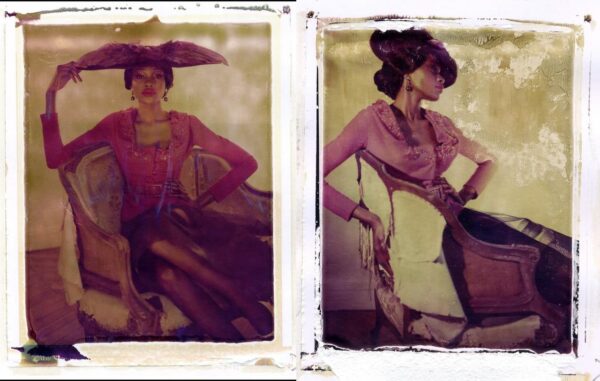
Sissi in John Galliano for Christian Dior Couture Fall/Winter 2009 – Cathleen Naundorf All rights reserved.
Your career must have given you many good stories and projects that make you the perfect guest at any dinner. Could you share a particularly memorable experience from your work that you still think about to this day?
In college, a friend and I used to daydream about appearing in a Maxwell music video, his rendition of ‘This Woman’s Work’ on constant repeat. Fast forward over a decade, I found myself not just appearing in his “Shame” visual, but art directing and executive producing it. The project even drew from a beauty course I’d developed. It was a full-circle moment, weaving together youthful musings and my adult professional reality.
As a jury member for the Global Footwear Awards, what do you prioritise when evaluating designs? What advice would you give to aspiring designers?
I gravitate towards designs that challenge conventions while honoring craftsmanship. To aspiring designers, I say: cultivate curiosity and skills beyond your industry, embrace risk-taking, and take a leap of faith. The net always appears, and what’s de layed is not denied.
What do you envision for the future, for the broader design community?
The next big innovations will continue to emerge from collaborations with people, fields,and techniques we don’t yet associate with fashion. There lie countless opportunities to thrive, regardless of one’s background.
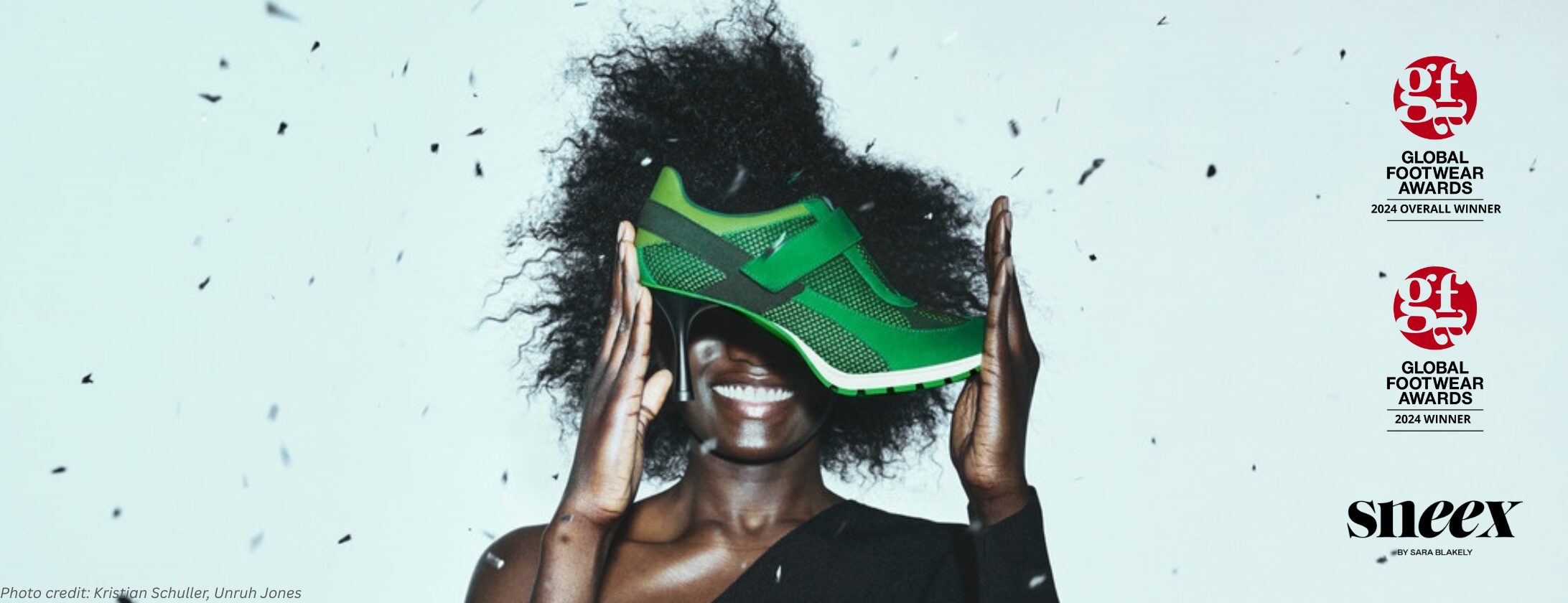
Meet Sara Blakely, designer of Sneex – The Tepper, winner of Best Overall in the Fashion Sneakers Category at the Global Footwear Awards 2024.
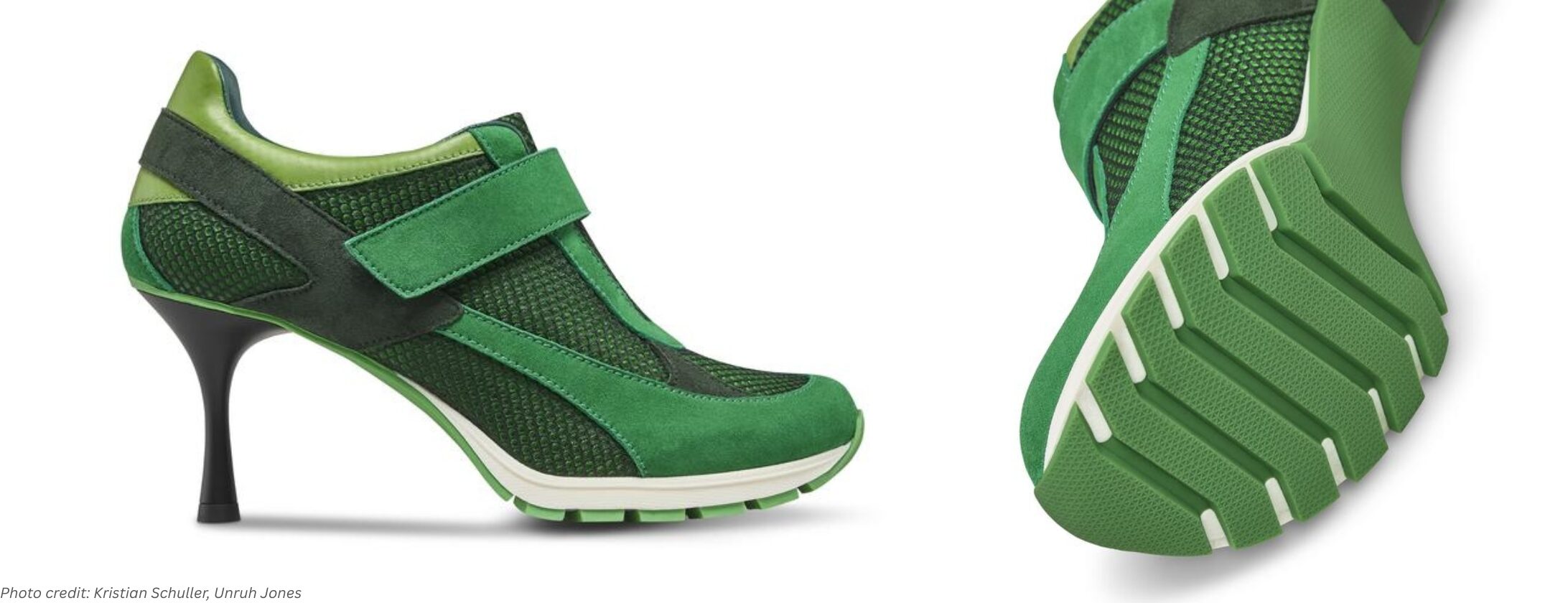
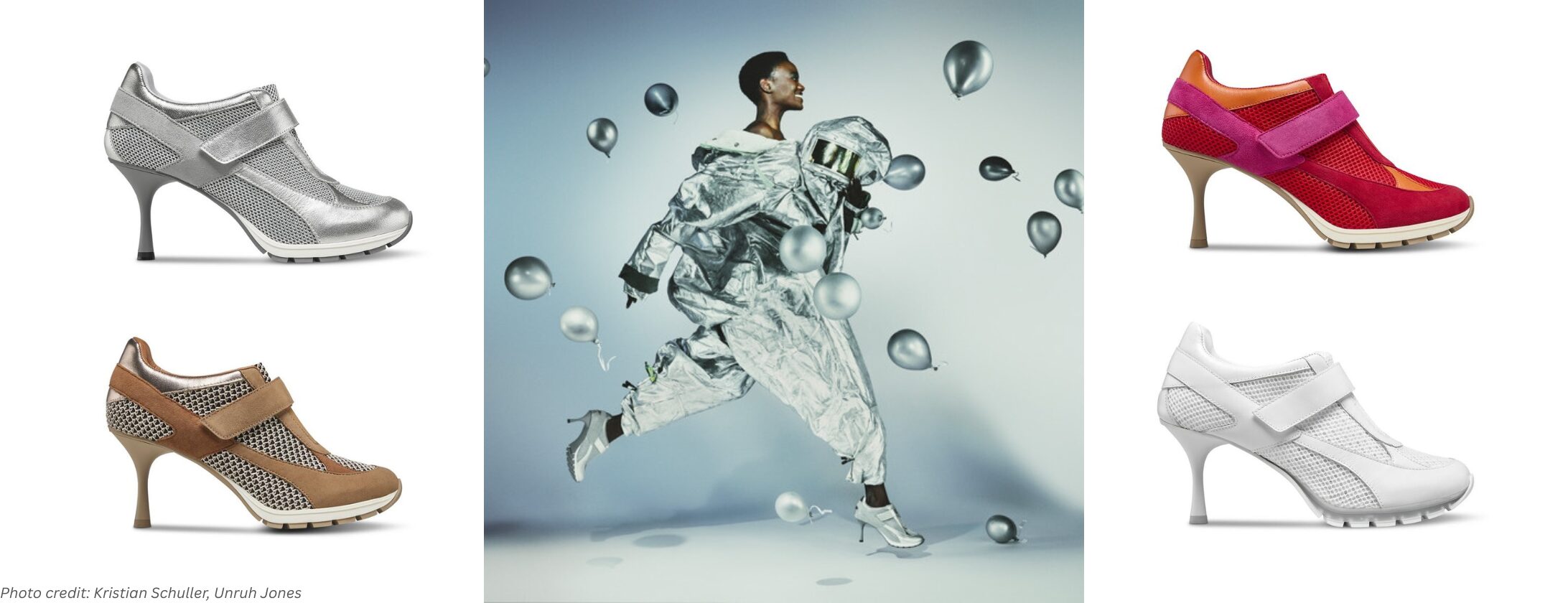
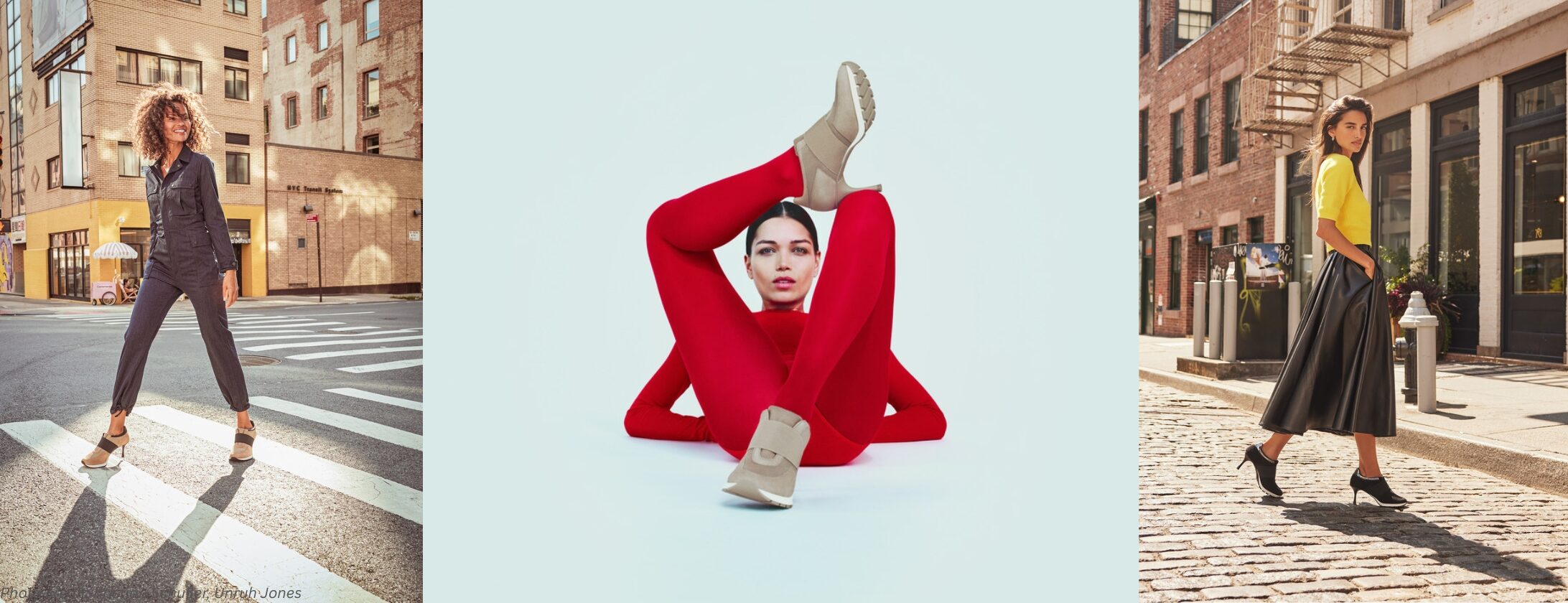
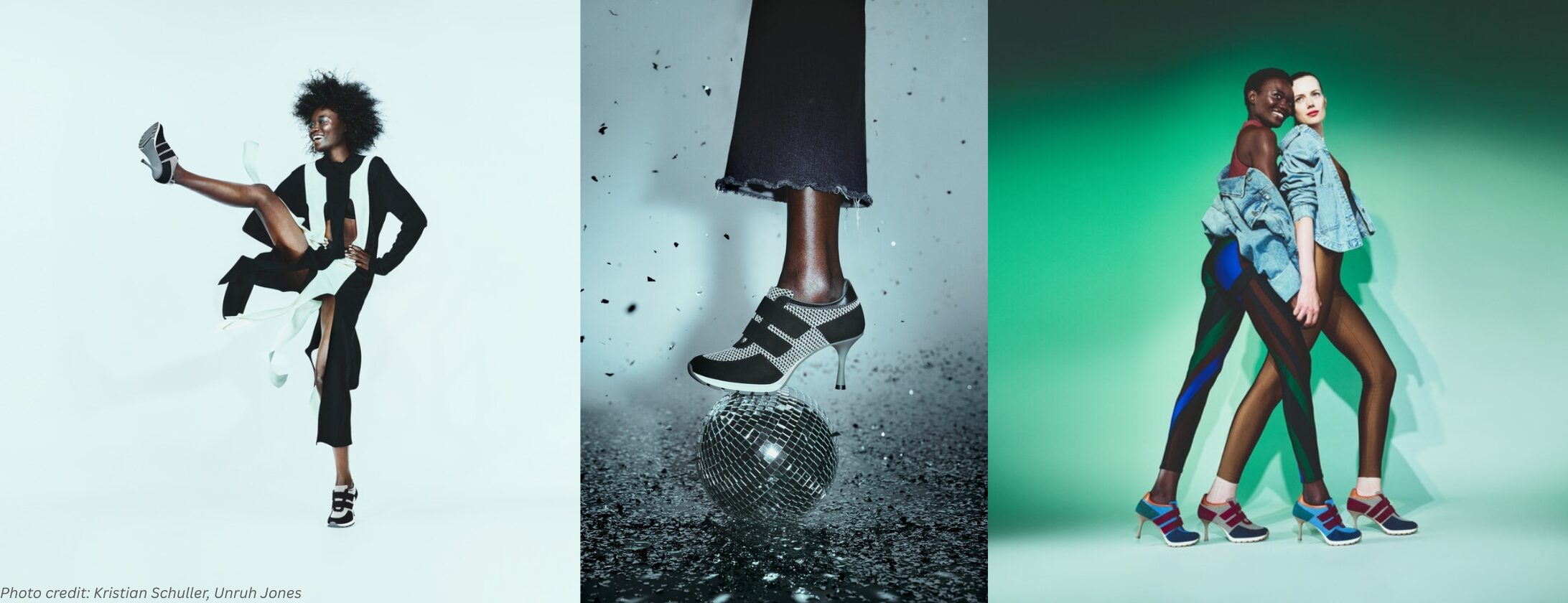
Sara created Sneex to solve a problem many women face: high heels that hurt. This hybrid design combines the sleek look of a stiletto with the comfort and support of a sneaker. Its bold silhouette, ergonomic structure, and versatile style redefine what heels can be—comfortable, stylish, and empowering.
In this interview, Sara shares the vision behind Sneex, her creative process, and the challenges she faced in creating this hybrid design.
Could you tell us about the origins of Sneex? What motivated its creation, and how has it evolved into its current identity?
I felt inspired to create this because of my own foot pain in heels. I also get fired up when something in the marketplace doesn’t change for long periods of time. I kept coming back to the idea that I wanted my high heel to feel as comfortable as my sneaker. I was also bored with the other options I had in my closet. I wanted a shoe that had height but reflected the current fashion trends. Sneex fill a void I felt in my own wardrobe. Our intention was to create a new option for women that was timeless and feminine, and that evoked feelings of confidence and power.
What inspired the creation of The Tepper? Was it a product of creative vision, or did it emerge in response to a specific market need or gap?
The Tepper (named after my daughter!) is our one strap style, the most premium of the current line. It has a more intricate design, and it’s made with luxe materials like Leone mesh from Italy. I named a style after her because I want Tepper to grow up knowing she does not have to sacrifice comfort to feel beautiful.
Sneex is unique for combining stilettos and sneakers. How did you balance these two styles to create a design that works so well together?
I set out to create the world’s most comfortable stiletto. I did not set out to create a sneaker heel. This is where the innovation led me. The lightbulb went off just as I was about to throw in the towel, until one day I said, “I just want my heel to feel as comfortable as my sneaker.” We re-engineered the weight distribution to relieve the pressure on the ball of your foot, we closed the gap most heels have between your foot and the shoe for whole-foot support AND we invented a design that prevents toe squeezing.
Through The Tepper, you’ve challenged the traditional look of high heels—and the pain that came with it. Could you explain how your design led to a comfortable yet stylish high heel?
In fashion, there has always been an ongoing battle between functionality and beauty. There’s almost always a compromise. I was inspired to say “what if? What if we didn’t need to compromise at all?” I wanted to design the most comfortable stiletto that was bold with a feminine aesthetic and versatile. Sneex is all about blending contrasting concepts in a beautiful way.
Can you describe some of the main challenges you faced in creating this hybrid design and how you addressed these issues?
It wasn’t easy! There were starts and stops and ups and downs. We spent years working to solve the main pain points that women commonly feel in high heels. The problem is that most people who make women’s high heels aren’t wearing them. There was a lot of resistance because we were challenging the way things have “always been done.” But my greater purpose has always been to give women better, more comfortable options. Even in times when I doubted myself, my purpose gave me the courage to keep going.
What do you think the rise of hybrid designs like The Tepper says about the evolution of fashion footwear?
Women want options. There’s this tension between beauty and comfort. I don’t believe they have to be mutually exclusive. I think with a few more prototypes and a little bit more attention to detail, love and care… beauty doesn’t have to be pain. You have to go the extra mile, but I think it’s worth it.
Congratulations on being the overall winner in Fashion Sneakers at the GFA Awards! How do you think this recognition will impact Sneex’s future?
Thank you… Thank you! We are so honored to receive this award. It confirms that Sneex resonate deeply with our audience and it has inspired us to continue innovating and creating products women love.
What does the future hold for Sneex? Are there any upcoming projects that you can tell us about?
New colorways will be launching in the spring, and brand new styles will be launching this Fall. I can’t wait!
Meet Wolfgang Laimer, a student at Konstfack—University of Arts, Crafts and Design. For his project Rapid Autografting, he won Best Overall in the Student Category at the Global Footwear Awards 2024.
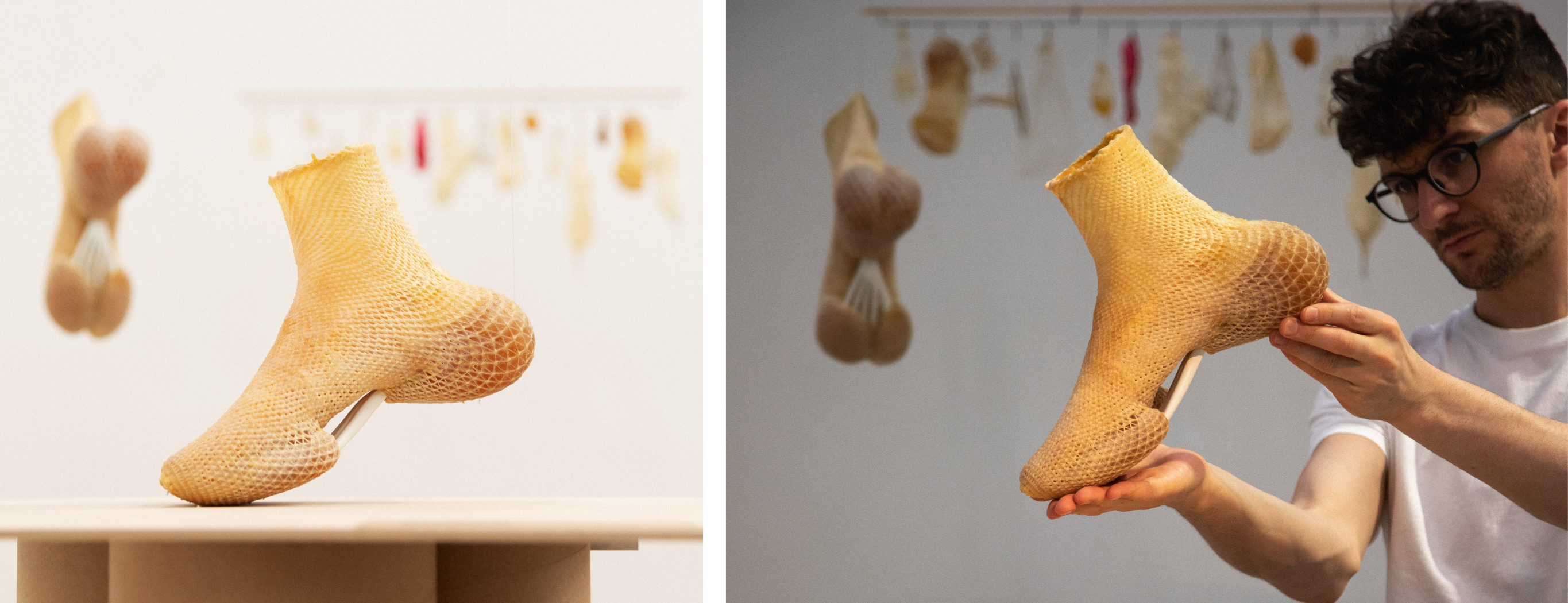
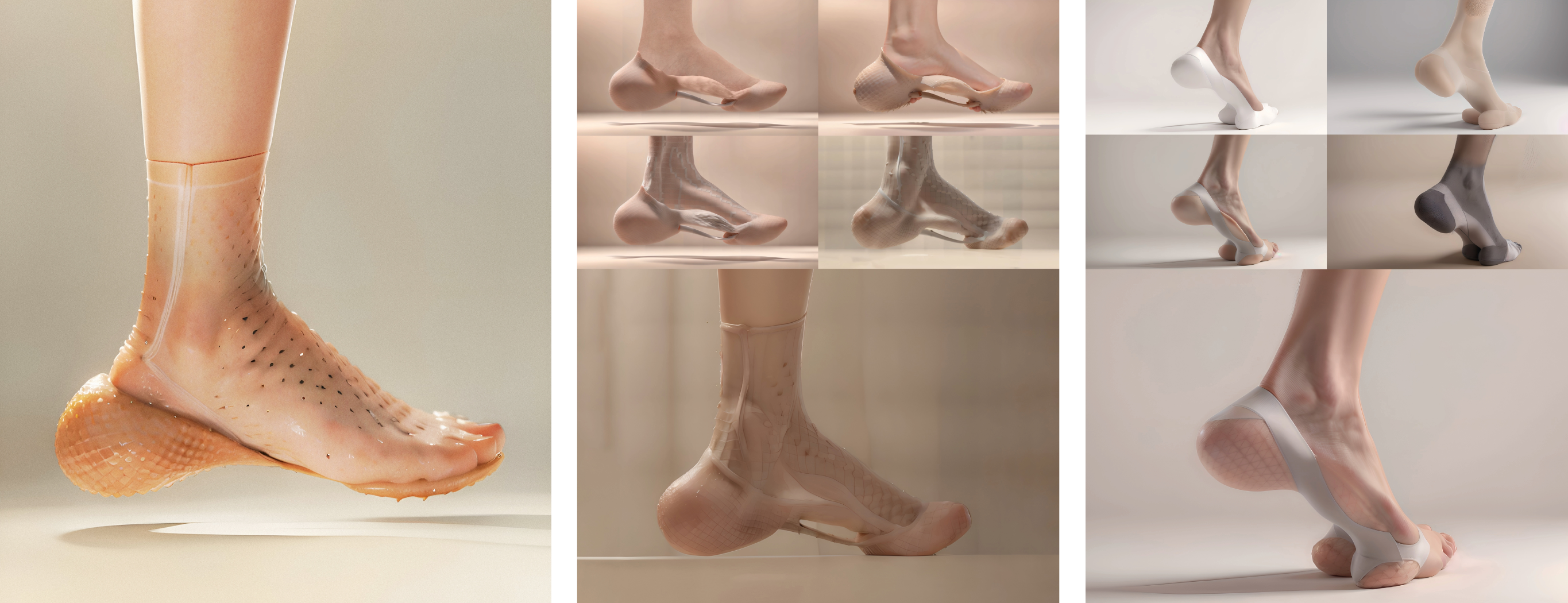
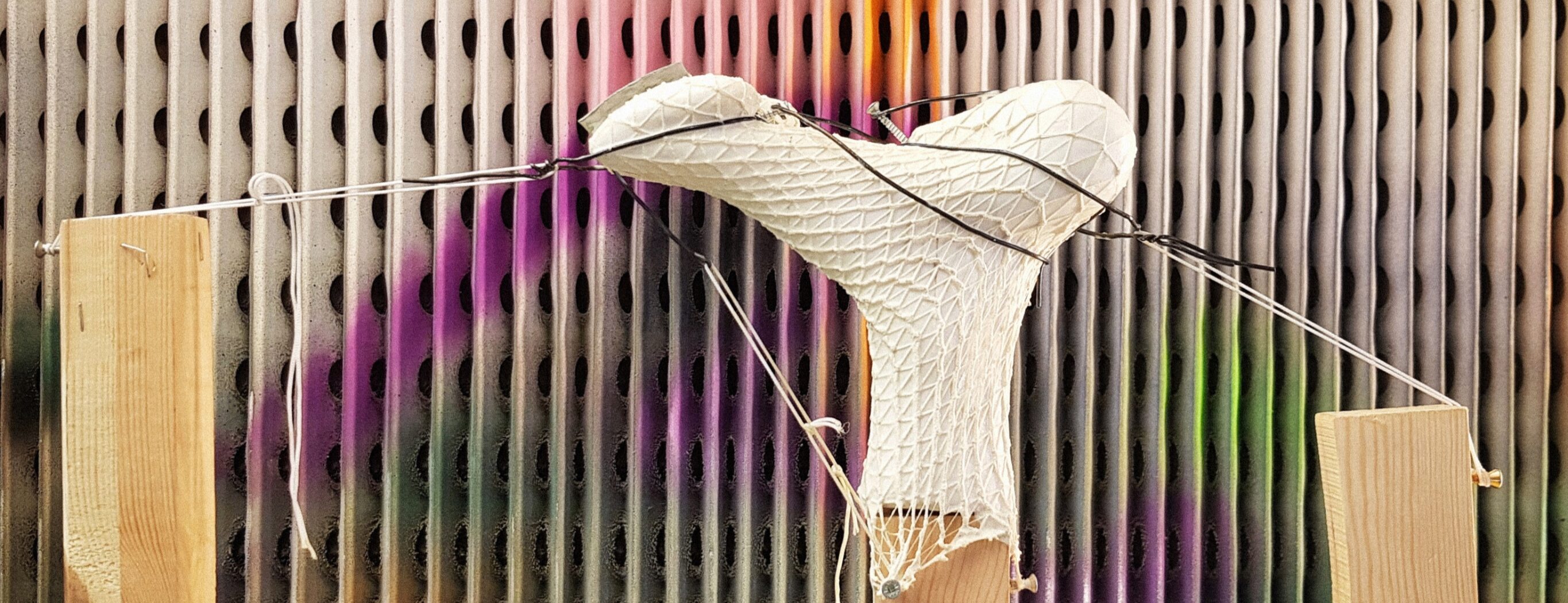
This project merges biotechnology with sports footwear, exploring its transformative potential. Rapid Autografting envisions a future where biomaterials enhance human physiology, creating a bioengineered bond between footwear and feet.
Wolfgang Laimer is an interdisciplinary designer who explores design, ecology, and philosophy. His work spans innovative footwear, multisensory products, and material research, using creative inquiry to address complex issues and redefine human-material interactions.
In this interview, Wolfgang shares his biggest challenges while developing Rapid Autografting and the key insights he gained from the process.
Can you tell us about your background? How did you discover your interest in design, and what would you say is your personal design philosophy?
I work between disciplines, methods, and perspectives. My path has taken me from carpentry to industrial design and design ecologies, alongside studying analytic philosophy. Designing footwear is particularly appealing to me because it uniquely combines function, culture, and identity. As an ultra-trail runner, I also understand the precision that footwear demands. I may not come from a traditional shoemaking background, but I greatly respect the craftsmanship and heritage of this field.
My work is not just about solving specific problems or creating beautiful objects but also about challenging perspectives. Designing in this way, similar to language, aims to shape perception—both as a means of communication and as a framework for structuring the world. In that sense, doing philosophy can be designed as well.
Can you expand on the idea behind Rapid Autografting? What inspired you to explore biotechnology and human augmentation through footwear design?
The body is an unstable system. We inject it with caffeine, cut it open, and wrap it in materials that partition it from its environment. I wanted to push beyond performance footwear as we know it. Most of today’s footwear innovations are based on the same formula—lighter, stronger, mand ore cushioned.
But what if the next frontier is not external in that sense at all? What if the shoe is not a thing but a phase—something that grows, adapts, and dissolves when it has served its purpose? The idea behind Rapid Autografting is to redefine footwear not as an object but as something entangled with our ever-changing physiology.
Can you walk us through the materials and technologies used in Rapid Autografting?
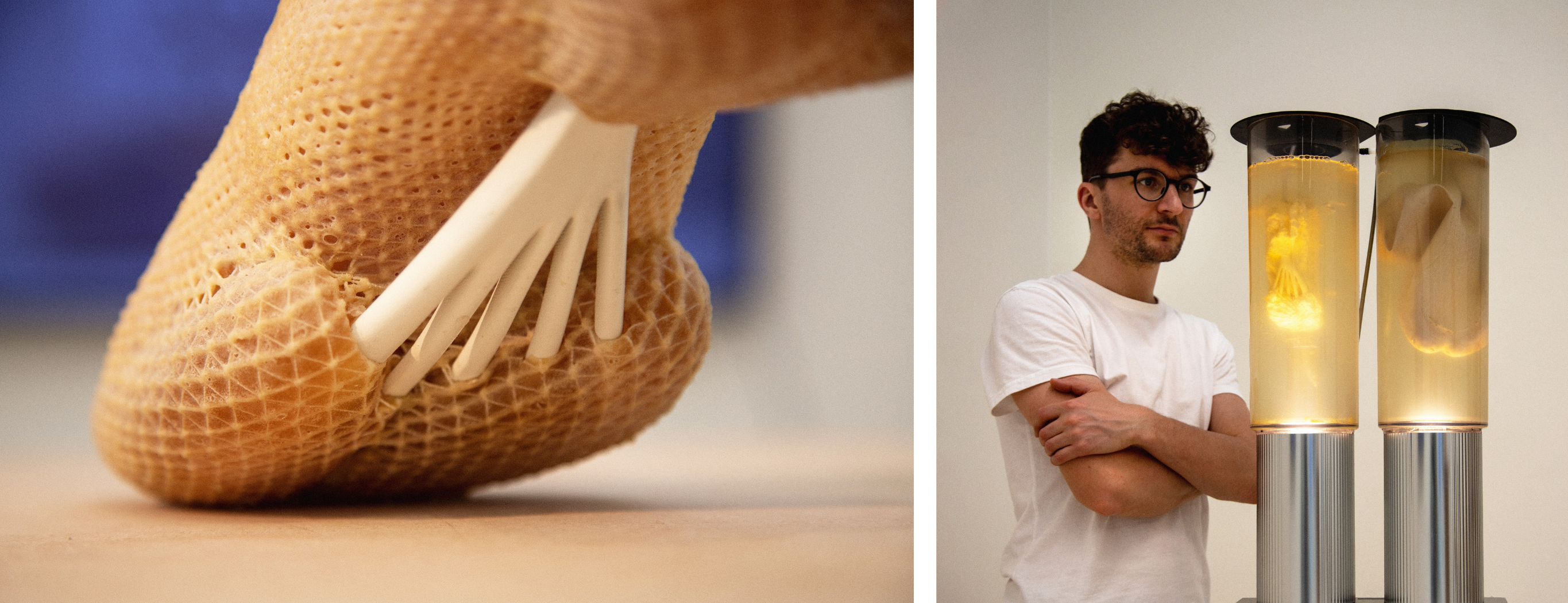
I worked with biofabricated materials like collagen, keratin, and gelatin. The key technology is 4D bioprinting, which is used in biomedical engineering. The idea is that you temporarily transform your foot for a race, a marathon, or a ritual—and after that, your body reabsorbs it. No waste, nothing to discard. It is never thrown away—it ceases to be a shoe.
To approximate this vision, I combined material exploration, 3D scanning, digital modeling, iterative prototyping through 3D printing, and many hands-on experiments. I used stretchable meshes, collagen, latex layers, and a gelatin-based cushioning system.
What considerations did you prioritize when deciding the visual and aesthetic aspects of the design?
The aesthetics emerged from biological logic—soft tissue, connective structures, and the way skin heals. It should make you feel like it evolved naturally rather than deliberately designed. There is also an unsettling quality because it does not look like regular shoes. The ambiguity in the visuals is intentional. It is messy. It does not ask to be liked but to be questioned.
What was the design process of Rapid Autografting, from the initial concept to the final product? What research methods or design techniques were most critical in shaping the outcome?
The design process was an exploration in multiple directions rather than a rigid step-by-step progression. I started by analyzing the foot’s physiological responses during running— perspiration and heat regulation. I spent a lot of time researching and understanding.
My focus shifted to callus. Often dismissed as unsightly, it is a remarkable biological adaptation that strengthens resilience. From there, material testing took over. More biology lab than design studio. If something collapsed, I did not “fix” it. Failure was key.
As a student, how did your academic environment influence the project? Do you think being a student presents unique challenges or opportunities?
As a student, being underestimated can be an advantage—it allows for greater creative risk. Konstfack provided an environment where I could explore such ideas without the immediate pressure of commercial viability or brand alignment. That freedom allowed this project to evolve in a way that might not have been possible within conventional constraints.
The ability to step outside the structured frameworks of industry, even temporarily, can generate insights that become valuable later on. In this sense, students have a unique opportunity to design for possible worlds beyond here and now.
What were the biggest challenges you faced during the development of Rapid Autografting? How did you solve these, and what did you learn from the process?
The biggest challenge was designing for an undefined future. It is like designing a spaceship without knowing the physics of the universe it would fly in. One solution for me was learning to embrace uncertainty. This sounds simple in retrospect, but it was not. I have learned that control can sometimes be limiting and is not always beneficial.
Congratulations on your win at the Global Footwear Awards! What does this recognition mean for you and your future in the sustainable design industry?
Thank you! I am honored to receive this recognition from the GFA, especially in the sustainability category. It is a sign that my ideas resonate beyond the academic context. Designing should perhaps not only sustain but also challenge the notion of products as static things. This award indicates that the industry is listening and is open to new ways of designing and innovating responsibly. Now, we can start the real work.
Looking ahead, what areas of design or research are you most interested in exploring? Are there any upcoming projects or concepts that you can tell us about?
I am fascinated by the relationship between humans and technology. One focus will continue to be exploring how movement, materials, and human capabilities can be redesigned, particularly in sports. Emerging technologies are increasingly dissolving the boundaries between product and body. As this distinction fades, so too does the line between what we are and what we might become. Footwear is a unique interface for designing these shifts, and I will continue pushing forward—again, working between disciplines, methods, and perspectives.
In Conversation with Matea Gluscevic: In Her Boots Designer & 2024 Overall Winner.
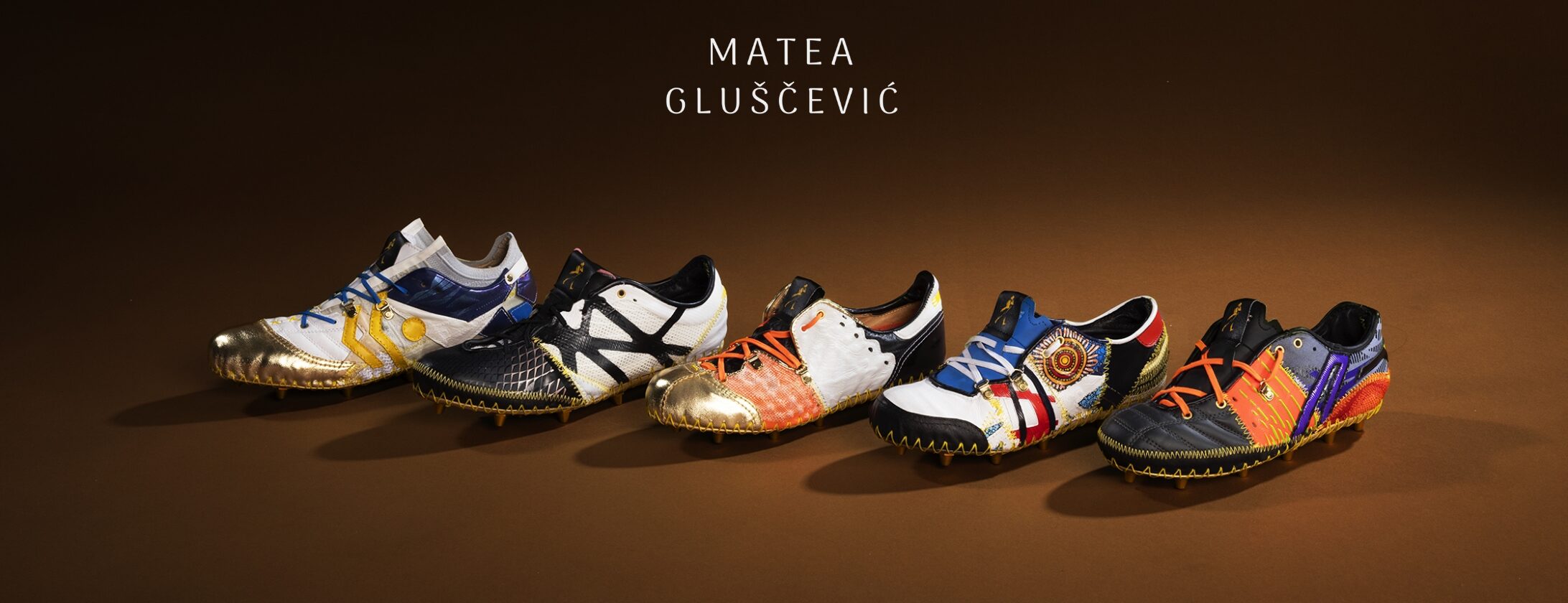
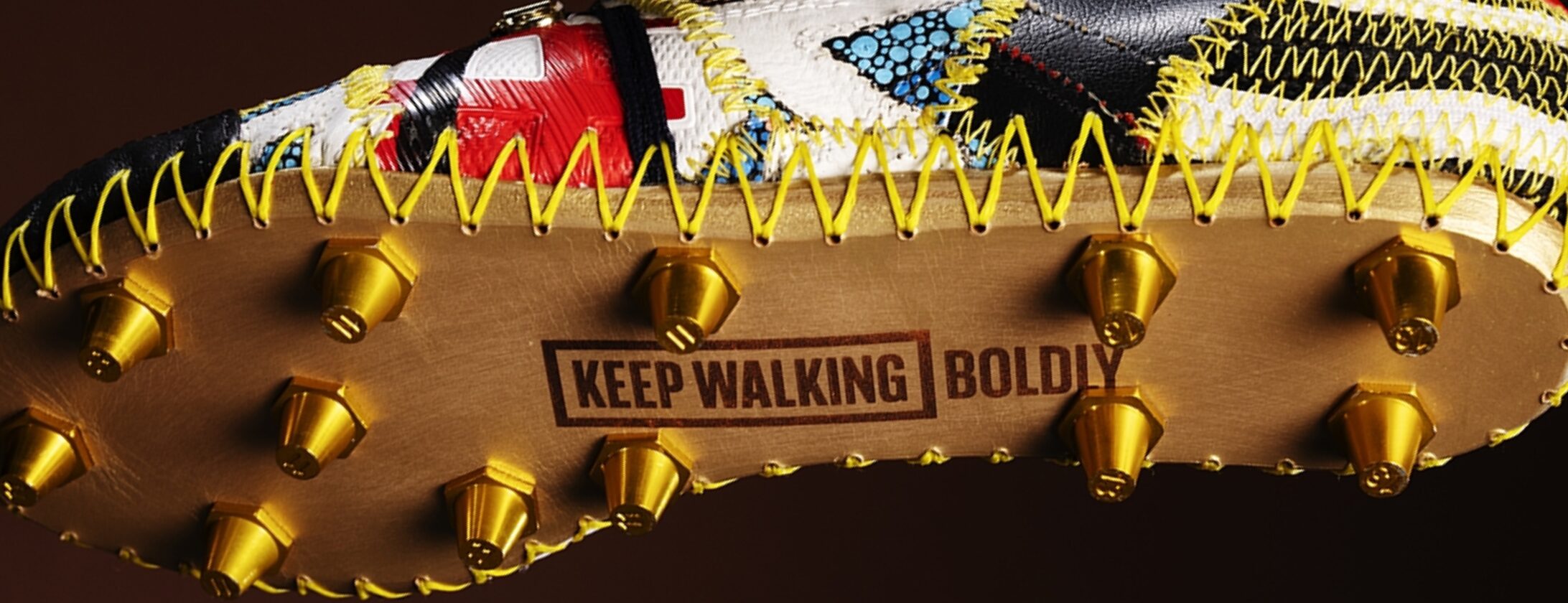
Matea Gluscevic shares the story behind In Her Boots, a collection of five football boots crafted from those worn by past icons of women’s AFL. For this, she was recognized with the Global Footwear Awards 2024, Best Overall Winner in the Independent Category.
A visionary in bespoke shoemaking, Matea’s work reflects her artistic spirit and mastery of Italian Lunati and Geometric pattern-making techniques. Her bold designs merge storytelling with craftsmanship, turning footwear into statements of functional beauty.
In this interview, she discusses her vision, creative process, and the challenges behind her brand.
Our conversation with Matea Gluscevic
Can you share the story behind your brand? How was it created, and what shaped its growth?
My brand is really just me, and the story is just that of my journey as a creative – it was created out of my own desire to create and design, and my life and opportunities have shaped its growth. The most notable things that have shaped the growth of my footwear work over the last 4 years are probably my participation in various fashion weeks in Australia, interest from the media, an apprenticeship with Master Shoemaker Eugenia Neave while I was in Adelaide, and the support I have received from those around me. I would also say that my drive to create functional wearable items has also been a big driver of my interest in footwear and the reason that I am doing what I am doing.
What is the vision behind In Her Boots, and how did the idea for the project come to be?
The vision came from the team at PXP Studios who were looking for a way to visually communicate progress in the AFLW as part of that “In Her Boots” campaign with AFLW and Johnnie Walker. Clearly, using boots from past players was a very literal and straightforward way to do this, and I think it was quite effective. I think they had heard about my work through one of their colleagues, and when they got in touch, I was more than happy to participate in such a thoughtful project.
The materials used in the collection were sourced from recycled shoes, what led you to this choice?
The team at PXP suggested I use the shoes from past players of the AFLW, as this would help visually communicate the narrative of progress in women’s sport which is what the In Her Shoes campaign was about and give the shoes real character and depth. This choice would also mean that we would have a much more visually interesting end product.
The collection has a striking visual design, why did you choose to create such a bold look?
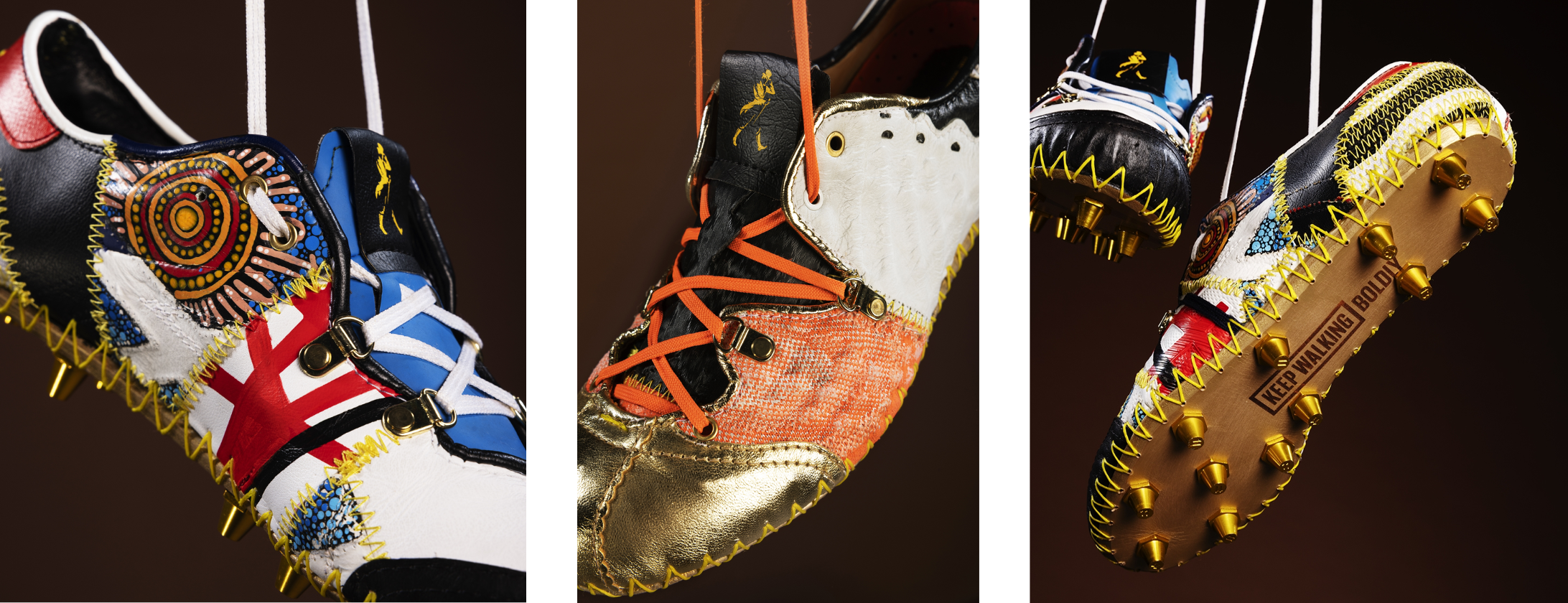
A bold look was important in order for these shoes to stand out as part of the campaign. I combined elements of ballet flat shoes, football shoes, bag making and obvious hand stitching in order to create a shoe that was aesthetically familiar as a sports shoe but still unique and with a distinctly handmade feel.
Can you walk us through the design process, from the initial ideation to the final product?
Initial ideation was led by the team at PXP with the suggestion of working with boots from past players. The design process was relatively rushed as we didn’t have much time, and was happening mostly in the form of my experimentation with materials and troubleshooting.
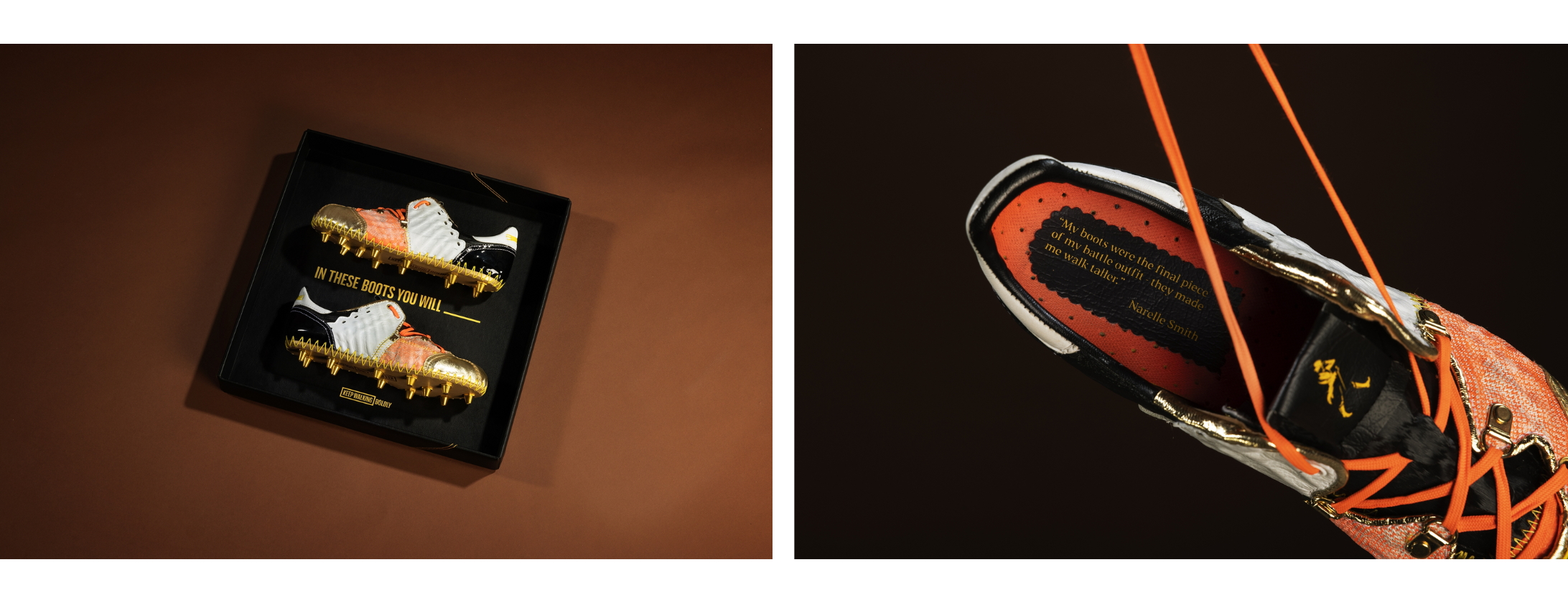
As a loose description of how that played out – I wanted to create something that had elements of what I consider femininity without being overtly feminine and something that felt like it combined old and new processes. I introduced the idea of having a topline that somewhat resembled a ballet flat shoe but with lace-up tabs and a tongue. This was well received by the team. From there, we resolved the branding aspects: laser etched tagline in the veg tan sole and screen printed logos on the tongue tabs. Then there was a period of play – where I explored the materials (old shoes) and how I could use them differently in each pair. For example, on one pair, I zigzagged old laces together into a panel that was used as the upper on a heel. In another pair, molded plastic branding was cut up and applied to other panels to create a new, vaguely sports-looking logo. Then I researched football boot cleats, and we considered using either new gold cleats or making my own from leather. Ultimately we decided that to get the right aesthetic balance, I would use the metal cleats. So you can see how it wasn’t really something that was fully resolved and then made, it was more of a loose idea that took shape as we worked and played through the making process.
How does your approach to sustainability in In Her Boots differ from other designs that also emphasize recycled materials?
With this project the main difference is that we focused on using recycled materials specifically from the past players shoes rather than just any random existing materials. Additionally while the vegetable tanned leather soles aren’t recycled, they are still sustainable and are a relatively uncommon material to use in this type of application at this point in time.
Can you tell us about some of the challenges you faced during the creation of In Her Boots? How did you address these difficulties?
Getting all the old shoes from past players was a bit of a challenge in terms of being able to meet our deadline for the project. I addressed this by making sure to work on aspects of the boots, like preparing soling, etc, and leaving the upper sewing right until the end, which is the opposite of my usual process. Including the branding/tagline was a bit of a challenge as we wanted it to stand out and look good but still fit with the handmade aesthetic of the shoes and be doable in our short timeframe. This was addressed by doing a few materials and processes tests and settling on hand-cutting and painting veg tan soles and then getting them laser etched, something I thought was a really nice example of old and new technologies coming together.
What lessons or insights did the experience of creating In Her Boots bring to you personally?
I guess I became more aware of some of the history of women’s sports in Australia, which was definitely interesting. I also realized that I generally enjoy working with a team and leading the design and manufacturing process. The experience also provided valuable insights into how the advertising/marketing industry works as well as experience with other design professionals in a context I hadn’t worked in before.
Congratulations on winning the overall sustainability prize at the GFA Awards! How does this recognition align with your brand’s goals, and what impact do you believe it will have on your future?
I have been striving for more industry recognition so this award aligns perfectly with my goals. I believe that winning this award will provide my brand/work with more global visibility and more opportunities to work on unique design projects. It has also increased my confidence in my own work and encouraged me to keep creating.
Looking ahead, what are your priorities for the brand? Are there any upcoming projects or collaborations you’re particularly excited about?
Currently, I have started a new brand, Cakey Sportsman which includes garments and accessories as well as footwear. I will still be creating bespoke footwear under my Matea Gluscevic brand and working on various creative footwear projects that come up, however I will now also be expressing myself more freely in all forms through the Cakey Sportsman brand. There is nothing in particular planned for this year yet, but there’s usually always something interesting that comes up – I can’t wait to see what it will be this year!